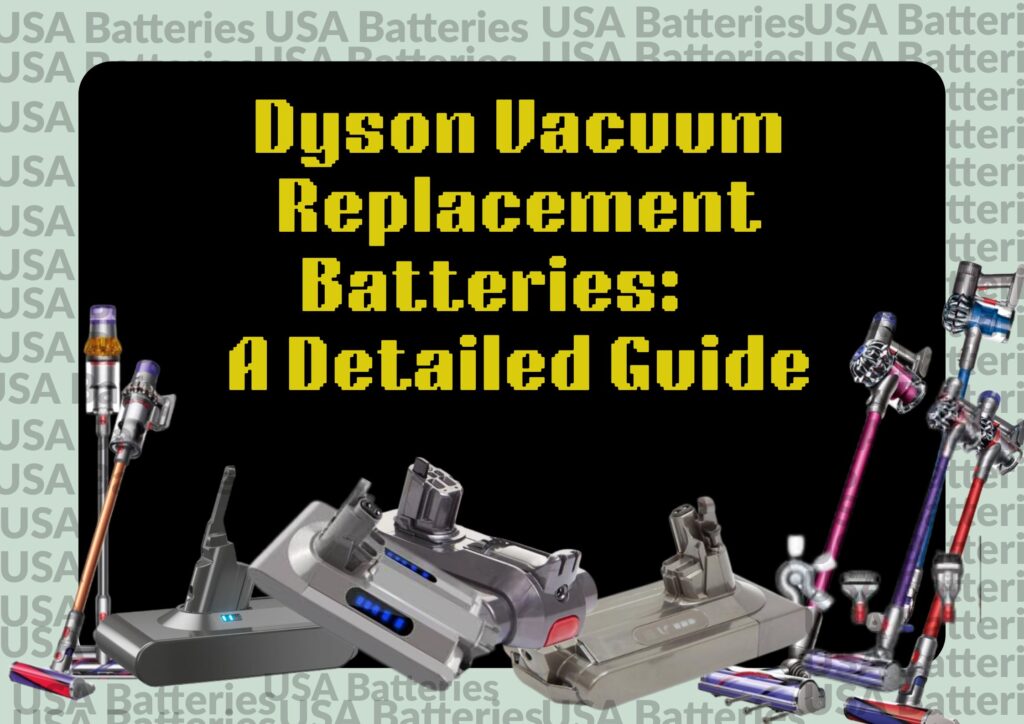



The journey of vacuum batteries began with the introduction of nickel-cadmium (NiCd) batteries, which were later replaced by nickel-metal hydride (NiMH) batteries due to their higher capacity and lower environmental impact. However, the real game-changer came with the adoption of lithium-ion (Li-ion) batteries, which offered a substantial improvement in energy density, charge retention, and overall performance.
Early Developments
Initially, vacuum cleaners were tethered to power outlets, limiting their mobility and convenience. The introduction of NiCd batteries provided the first semblance of portability, though these batteries suffered from the infamous “memory effect,” reducing their effective lifespan. NiMH batteries mitigated some of these issues but still fell short in terms of energy density and weight.
The limitations of NiCd and NiMH batteries were evident in their relatively short runtimes and frequent need for recharging. Users often found themselves frustrated by the need to recharge their vacuum cleaners frequently, hindering the overall cleaning experience. Despite these drawbacks, the advent of portable battery-powered vacuum cleaners marked the beginning of a new era in household cleaning.
Another significant challenge with early battery technologies was their environmental impact. NiCd batteries, in particular, contained toxic cadmium, posing disposal and recycling challenges. The transition to NiMH batteries was a step forward in reducing environmental harm, but it was the development of Li-ion batteries that truly addressed these concerns.
The Lithium-Ion Revolution
The advent of Li-ion batteries marked a significant leap forward. These batteries not only provided higher energy density but also exhibited minimal memory effect and longer lifespans. This transition enabled manufacturers to produce more powerful, longer-lasting, and lighter vacuum cleaners, thereby revolutionizing the industry.
Li-ion batteries offered a substantial increase in energy density, allowing for longer runtimes and more consistent power output. This innovation enabled vacuum cleaners to maintain strong suction power throughout their usage, enhancing cleaning efficiency. Additionally, Li-ion batteries were lighter and more compact, contributing to the overall portability of cordless vacuum cleaners.

by Alexandre Debiève (https://unsplash.com/@alexkixa)
One of the most notable advantages of Li-ion batteries is their reduced memory effect. Unlike NiCd batteries, Li-ion batteries do not suffer from significant capacity loss when recharged before being fully discharged. This characteristic extended the effective lifespan of the batteries, reducing the need for frequent replacements and providing a more reliable cleaning solution.
The environmental benefits of Li-ion batteries were also significant. With fewer toxic materials and a longer lifespan, Li-ion batteries contributed to a more sustainable approach to battery-powered appliances. Manufacturers, recognizing these advantages, rapidly adopted Li-ion technology, leading to a new generation of advanced cordless vacuum cleaners.
Ongoing Innovations
The evolution of vacuum batteries is a continuous process, with ongoing research and development aimed at further enhancing their performance and sustainability. Advances in battery chemistry, materials, and manufacturing processes are driving the creation of next-generation vacuum batteries that promise even greater capabilities.
Researchers are exploring new materials such as silicon anodes and solid-state electrolytes, which could significantly increase energy density and improve safety. These innovations have the potential to extend the runtime of cordless vacuum cleaners and reduce charging times, further enhancing their convenience.
Additionally, advancements in battery management systems (BMS) are playing a crucial role in optimizing battery performance. BMS technologies enable real-time monitoring of battery health, temperature, and usage patterns, ensuring that vacuum cleaners operate at peak efficiency and longevity. These systems can also provide users with valuable insights into battery maintenance and usage.
As the demand for more efficient and environmentally friendly cleaning solutions continues to grow, the evolution of vacuum batteries remains a focal point of innovation. The future holds exciting possibilities for even more powerful, longer-lasting, and sustainable vacuum batteries that will further revolutionize household and commercial cleaning.
Technological Insights into Dyson Vacuum Batteries
Dyson has been at the forefront of integrating advanced battery technology into their vacuum cleaners. Let’s take a closer look at some of their prominent models and the batteries that power them.
Dyson V6 Battery
The Dyson V6 was one of the earliest models to feature a Li-ion battery, providing up to 20 minutes of fade-free suction. The battery’s compact design and efficient energy management set the stage for subsequent advancements in Dyson’s cordless vacuum lineup.
The V6’s battery showcased the potential of Li-ion technology, offering a significant improvement over earlier models with NiCd and NiMH batteries. Users appreciated the consistent suction power throughout the battery’s runtime, making it an ideal choice for quick and efficient cleaning tasks. The compact design of the Dyson V6 battery also contributed to the vacuum cleaner’s lightweight and maneuverable nature.

by Zoltan Tasi (https://unsplash.com/@zoltantasi)
Despite its early success, the V6 battery had its limitations in terms of runtime. With only 20 minutes of usage on a single charge, users often found themselves needing to recharge the battery frequently for extended cleaning sessions. This limitation highlighted the need for further advancements in battery capacity and performance.
Dyson V7 Battery

by Possessed Photography (https://unsplash.com/@possessedphotography)
The Dyson V7 battery improved upon its predecessor with a slightly larger capacity, offering up to 30 minutes of runtime. Its quick-release mechanism allowed for easier battery replacement, addressing one of the common pain points of earlier models.
The introduction of the V7 battery marked a step forward in addressing the runtime limitations of the V6. With an additional 10 minutes of usage, users experienced greater flexibility in their cleaning routines. The quick-release mechanism was a welcome innovation, allowing users to easily swap out batteries and continue cleaning without interruption.
The V7 battery also featured improved energy management, optimizing power usage to extend the overall lifespan of the battery. This enhancement reduced the frequency of Dyson battery replacements, contributing to a more cost-effective and sustainable cleaning solution. The V7’s battery improvements set the stage for further advancements in Dyson’s cordless vacuum lineup.
Dyson V8 Battery
With the Dyson V8, the battery technology saw further enhancements, delivering up to 40 minutes of powerful suction. The V8’s battery also introduced a more efficient power management system, optimizing energy usage and extending the battery’s overall lifespan.
The Dyson V8 battery’s increased capacity provided users with a significant boost in runtime, making it suitable for more extensive cleaning tasks. The efficient power management system ensured that the vacuum cleaner maintained consistent suction power throughout its usage, enhancing cleaning performance. Users appreciated the longer runtime and improved efficiency, which reduced the need for frequent recharging.

by Robin LE MEE (https://unsplash.com/@rlemee_)
The V8 battery also featured advancements in thermal management, preventing overheating and ensuring safe operation. This enhancement contributed to the overall reliability and durability of the vacuum cleaner, providing users with a dependable cleaning solution. The V8 battery’s innovations marked a significant milestone in Dyson’s commitment to advanced battery technology.
Dyson V10 Battery
The Dyson V10 battery represented a significant leap in terms of capacity and performance. With up to 60 minutes of runtime, it became a benchmark for cordless vacuum cleaners. The V10’s battery also featured advanced thermal management and improved charge retention, making it one of the most reliable options in the market.
The V10 battery’s extended runtime allowed users to tackle large cleaning tasks without the need for frequent recharging. This innovation was particularly beneficial for users with larger homes or commercial spaces, where uninterrupted cleaning was essential. The advanced thermal management system ensured that the battery operated safely and efficiently, even during prolonged usage.
The improved charge retention of the V10 battery meant that users could store the vacuum cleaner for longer periods without significant capacity loss. This feature enhanced the overall convenience and reliability of the vacuum cleaner, making it a popular choice among consumers. The V10 battery’s innovations set a new standard for performance and efficiency in cordless vacuum cleaners.
Dyson V11 Battery
The Dyson V11 battery pushed the boundaries even further, offering intelligent power management that automatically adjusted suction power based on floor type. This adaptive technology not only maximized cleaning efficiency but also optimized battery usage, providing up to 60 minutes of runtime on a single charge.
The V11 battery’s intelligent power management system represented a significant advancement in vacuum cleaner technology. By automatically adjusting suction power based on the type of flooring, the V11 optimized cleaning performance while conserving battery life. This adaptive approach ensured that users achieved the best results with minimal effort.
The V11 battery also featured real-time monitoring and display of battery status, providing users with valuable insights into remaining runtime and maintenance needs. This feature enhanced the overall user experience, allowing for more efficient and informed cleaning routines. The V11 battery’s innovations solidified Dyson’s position as a leader in advanced cordless vacuum technology.
Comparative Analysis
| Model | Battery Type | Runtime | Key Features | Compatible Models |
|---|---|---|---|---|
| Dyson V6 | Li-ion | Up to 20 mins | Compact design, fade-free suction | V6 Fluffy, V6 Animal, V6 Absolute |
| Dyson V7 | Li-ion | Up to 30 mins | Quick-release, improved capacity | V7 Trigger, V7 Allergy, V7 Motorhead, V7 Fluffy |
| Dyson V8 | Li-ion | Up to 40 mins | Efficient power management | V8 Fluffy, V8 Animal, V8 Absolute, V8 Trigger, V8 Allergy, V8 Motorhead |
| Dyson V10 | Li-ion | Up to 60 mins | Advanced thermal management | V10 Absolute, V10 Animal, V10 Fluffy, V10 Torque Drive |
| Dyson V11 | Li-ion | Up to 60 mins | Intelligent power management | V11 Absolute, V11 Animal, V11 Fluffy+, V11 Torque Drive |
| Dyson V12 | Li-ion | Up to 60 mins | Powerful suction, long runtime | V12 Detect Slim, V12 Slim Fluffy, V12 Detect Complete |
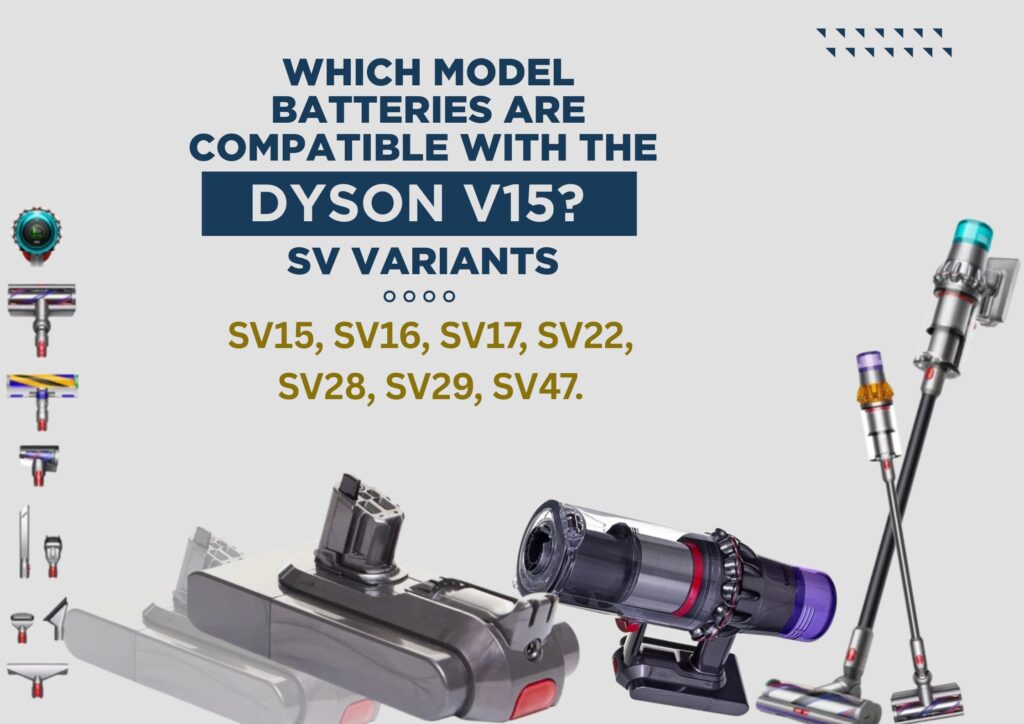
| Dyson V15 | Li-ion | Up to 75 mins | Laser Slim Fluffy, HEPA filtration | V15 Detect Complete, V15 Outsize |
Dyson Vacuum Cleaner Battery Models
Practical Applications and Benefits
The advancements in vacuum battery technology have had a profound impact on various aspects of daily life and industry practices.
Enhanced Portability and Convenience
Cordless vacuum cleaners powered by advanced batteries have freed consumers from the constraints of power cords, allowing for more flexible and efficient cleaning. This portability is particularly beneficial in larger homes and commercial spaces where maneuverability is crucial.
The absence of power cords enables users to navigate around furniture and obstacles with ease, reducing the time and effort required for cleaning. This increased mobility is especially valuable in multi-story homes and large commercial areas, where plugging and unplugging the vacuum cleaner can be cumbersome.
Additionally, the lightweight nature of cordless vacuum cleaners enhances user comfort and reduces fatigue during extended cleaning sessions. Users can carry the vacuum cleaner from room to room or up and down stairs without strain, making cleaning a more pleasant experience. The convenience of cordless vacuum cleaners has led to their widespread adoption in both residential and commercial settings.
Improved Cleaning Performance
The high energy density of Li-ion batteries enables vacuum cleaners to maintain consistent suction power throughout their runtime. This ensures thorough cleaning, even in challenging environments, and enhances the overall user experience.
Consistent suction power is essential for effectively removing dirt, dust, and debris from various surfaces. Whether cleaning carpets, hardwood floors, or upholstery, the reliable performance of Li-ion
Conclusion
In summary, the evolution of vacuum batteries has dramatically transformed the landscape of household and commercial cleaning. From the early days of nickel-cadmium batteries to the modern advancements in lithium-ion technology, manufacturers have continuously sought to enhance battery performance, sustainability, and user convenience.
The introduction of lithium-ion batteries marked a significant milestone, providing longer runtimes, reduced weight, and improved charge retention. Notable models like the Dyson V6, V7, V8, V10, and V11 exemplify the remarkable advancements in battery technology, each iteration offering enhanced performance and innovative features tailored to meet consumer needs.
As research continues into new materials and battery management systems, the future promises even greater innovations in vacuum battery technology, ensuring a more efficient and eco-friendly cleaning experience. With ongoing efforts to optimize performance and sustainability, vacuum batteries will remain a vital component in redefining cleaning solutions for years to come.
table { border: 1px solid #ccc; text-align: center; }